- What are your missions within the framework of the Life SOS Crau Grasshopper project?
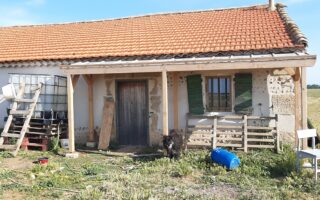
For the past 8 years, I have been working with the Conservatoire d’espaces naturels de Provence-Alpes-Côte d’Azur as a conservation biologist for the Crau Plain Grasshopper. Today, I coordinate both ex situ and in situ breeding. There are now 3 ex situ breeding stations (the Barben animal park, the Besançon zoological park and my station in Corrèze), and 2 in situ breeding stations. The aim is to improve the success of captive breeding by increasing the number of hatchlings and the survival rate of young grasshoppers. In the long term, this should enable us to increase the population of Crau Plain Grasshopper by reintroducing individuals into the natural environment.
- What issues are you facing?
Year after year, we learn more about the Crau Plain Grasshopper. The species is very specialised. If it is only found in the Crau, it is not by chance. It is totally adapted to this environment, which is also very particular. As a result, it is difficult to decipher the conditions necessary for its development, to carry out its complete development cycle and to reproduce them in an artificial way.
- What are the difficulties encountered?
The experimentation time is short. We can only observe the locusts for three or four months, because the life span of the Crau Plain Grasshopper is short. As a result, we can have the feeling that we are not making any progress very quickly, but we are nevertheless accumulating knowledge as we go along. In particular, observing the behaviour of grasshoppers in a terrarium teaches us a great deal. It fascinates me.
One of the puzzles that still needs to be solved is that we don’t know exactly how females lay their eggs in their natural environment and what conditions are necessary for the eggs to develop properly. We don’t know how they choose their egg-laying site, or how they deposit the egg pod in the ground.
- How does the Crau Plain Grasshopper differ from other species benefiting from a protection programme?
The Crau Plain Grasshopper is the first insect species in the world to have benefited from a conservation strategy developed according to IUCN standards. While the massive and rapid decline of insects is recognised by all, the vast majority of conservation programmes concern mainly mammals and birds.
Do you have a message for people who don’t know the Crau Plain Grasshopper?
In a more general way, be interested in the small animals around us, not only mammals and birds, which are more visible, more attractive, more interesting, more emotional. All the little creatures around us have a role. Even if sometimes it is less spectacular.
The Crau Plain Grasshopper plays its role in the Crau ecosystem, and it is up to us to preserve it.
Interview by Gaïa Ollivier